Information sharing in healthcare systems is one among the major issues which needs to be given a reasonable attention. To overcome the problem in many medical institutions opted for e-healthcare system. E-healthcare is becoming one among the vital topics in healthcare organizations (Dwivedi et al. 2002). Healthcare information systems face difficulties in implementing and maintaining these computing systems. This section of the proposal will review literature which addresses the whole information sharing in health system topic. First, this section will discuss on the problems facing the institutions information sharing and major drawbacks of using the current system. Second, the solution to be proposed that is cloud computing will be discussed; defining cloud computing and discussing the benefits cloud computing provides. Third, the literature will examine how cloud computing would fit healthcare system, specifically in Tanzania. Lastly, challenges and problems which are potentially to be faced will be highlighted.
Due to huge amount of data, hospitals face a lot of problems in sharing and storing data (Omary et al. 2009; Xinlei and Wang 2010). The amount of data to be processed and shared is so large and has made the whole process of storage a very laborious work. In Tanzania data is taken manually and stored using the traditional hard paper files. This is very expensive and time consuming work (Omary et al. 2009). According to Omary et al. (2009) the major problems using the traditional system it leads to data duplication, incomplete and irrelevant information. To overcome the problem Omary et al. (2009) suggest e-healthcare should be implemented in Tanzania. But then there rise another issue of installation and maintenance of the systems. Installation process involves cabling and purchase and installation of necessary hardware and software. In fact, the medical institutions have to invest money and manpower to implement e-healthcare (Rolim et al., 2010). Martinez et al. (2005) claim that the distance between the rural areas and the urban is huge in developing countries which make data sharing more difficult. There arises a problem “to see a doctor is difficult, to see a doctor is expensive”. Developing countries like Tanzania needs cloud computing to overcome the distance, have cost-effective healthcare and to have a proper data management system.
The proposed solution of the problems mentioned above is cloud computing. By definition cloud computing is the means though which computer infrastructure and capabilities are provided regardless of time and location (Wang and Tan, 2010). According to Wang and Tan (2010) all products provided by the cloud is viewed as a service. From the definition, cloud computing provides processing, distribution and storage services. Therefore Hospitals and medical institutions will not be forced in acquiring unnecessary hardware and software (Wang and Tan, 2010). Wei and Blake (2010) add that the institutions would pay for what they use, that is in the mode of “pay as you go”. The benefits of implementing cloud computing is that maintenance is easy, user only has to connect PC to the internet (Rolim et al., 2010). From the above we learn that cloud computing offers a very ideal solution for computing in Tanzania; it overcomes cost, availability and technical issues. The question to be asked, how cloud computing can solve the problem “seeing a doctor is difficult, seeing a doctor is expensive” in Tanzania healthcare system?
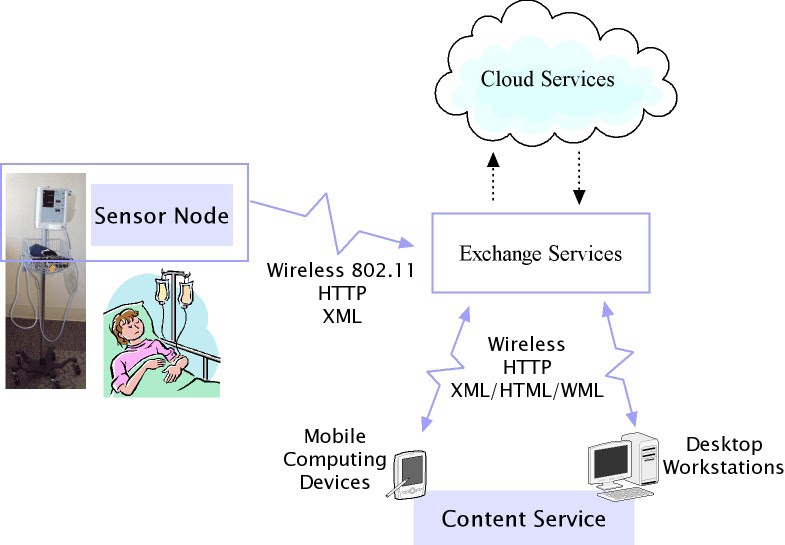
Bonacina et al. (2007) propose a system which uses a web-based platform which keeps medical information of a family. The proposed system may resemble cloud computing but it is not pure implementation because first the system is not connected to medical center system. That is it is a standalone application. Hence the system architecture does not comply with the definition of accessing the capabilities and infrastructure of computers whenever and wherever. Another system (Diag. 1) which uses censors to monitor patients’ heart rate and upload the data to the hospital cloud by Rolim et al. (2010). But then the acquiring of censors would cost more money and the aim is to minimize cost as possible. However, seemingly if we minus the censor part of the system and make little adjustments, the later proposed system looks the suitable cloud computing system to be implemented in Tanzania.
Diag.1: One of the implementations of cloud computing in Healthcare institutions
(Source: Rolim et al. 2010)
The above system is one among possible implementations of cloud computing systems in healthcare systems. The Rolim et al. (2010) proposed system will overcome the distance issue and facilitate telemedicine. Telemedicine is defined by Rolim and colleagues as providing treatment remotely. Thus medical clinics situated in rural can access and distribute medical information to regional and national hospitals. According to them this will help small rural hospitals to manage drug supply, financial management and even provide collaborative medical care. Furthermore, in general taking from the system, cloud computing will help mobilize healthcare (Bonacina et al., 2007). Wan and Tan (2010) add that cloud computing provides cost effective healthcare and provides a suitable base for medical information sharing. Therefore from the literature reviewed, it seems like cloud is prime candidate as a computing method to implement in Tanzania healthcare. It overcomes cost, distance, technical know-how and moreover it facilitates collaborative medicine.
On the other there are some challenges and security risk concerning implementation of computing. Omary et al. (2009) are concerned with lack unique identifier, lack of funds and internet availability. Currently, Tanzania is connected to optic fiber cable passing from South Africa to India and then connecting to Europe. Therefore, in Tanzania internet and bandwidth is no longer an issue. In addition to that there are other concerns like resistance to attacks and protection from SQL-injections (Wei and Blake 2010). These issues can be overcome with encryption and proper programming. The biggest challenge seems to be the popularization of cloud computing in Tanzania. Seemingly, cloud computing is a very new concept in Tanzania.
In conclusion, from literature review cloud computing would be a very suitable implementation in e-healthcare of Tanzania. Tanzania as developing needs a very cost-effective system and less laborious to reduce cost on staff. The literature has highlighted on challenges and risk which some of them are already eradicated or could be solved with available methods. Cloud computing is a new topic in Tanzania, but from the literature reviewed it is a topic which worth a study. No errors allowed in medical information and cloud computing is tool to ensure that.
Reference:
(2005). Analysis of information and communication needs in rural primary health care in developing countries. Information Technology in Biomedicine, IEEE Transactions on, 9 (1), 66.
BONACINA, Stefano, et al. (2007). A Web-Based System for Family Health Record. In: Engineering in Medicine and Biology Society, 2007. EMBS 2007. 29th Annual International Conference of the IEEE , Lyon, 22-26 August 2007. Milan, Bioengineering Department, Politecnico di Milano, Milan, I-20133 Italy. phone, p.3652.
DWIVEDI, A., et al. (2002). Workflow management systems: the healthcare technology of the future? In: Engineering in Medicine and Biology Society, 2001. Proceedings of the 23rd Annual International Conference of the IEEE , u.k, 2001. u.k, Sch. of Math. & Inf. Sci., Coventry Univ., UK, p.4.
GROBAUER, Bernd, WALLOSCHEK, Tobias and STOCKER, Elmar (2011). Understanding Cloud Computing Vulnerabilities. Security & Privacy, IEEE , 9 (2), 50.
OMARY, Z., et al. (2009). Challenges to E-healthcare adoption in developing countries: A case study of Tanzania. In: Networked Digital Technologies, 2009. NDT '09. First International Conference on , 28-31 July 2009. Ostrava , Dublin Inst. of Technol., p.201.
ROLIM, C.O., et al. (2010). A Cloud Computing Solution for Patient's Data Collection in Health Care Institutions. In: eHealth, Telemedicine, and Social Medicine, 2010. ETELEMED '10. Second International Conference on, St. Maarten, 10-16 Feb. 2010. Florianopolis, Network & Manage. Lab.-LRG, Fed. Univ. of Santa Catarina, p.95.
WANG, Xinlei and TAN, Yubo (2010). Application of cloud computing in the health information system. In: Computer Application and System Modeling (ICCASM), 2010 International Conference on , Taiyuan, 22-24 October 2010. , V1-179.
WEI, Yi and BLAKE, M.B. (2010). Service-Oriented Computing and Cloud Computing: Challenges and Opportunities. Internet Computing, IEEE , 14 (6), 72.